
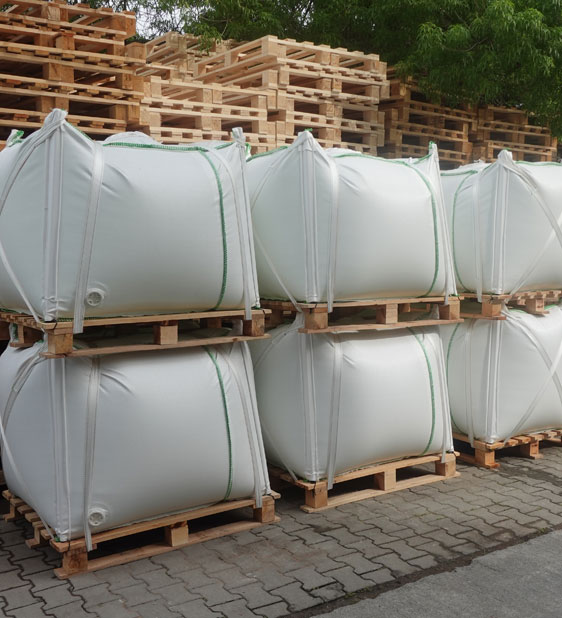
For years, the IBC tank (Intermediate Bulk Container) has been the industry standard for transporting liquids in the 1000L (1 m³) range. However, as supply chains become more cost-driven and efficiency-focused, companies are actively searching for IBC alternatives that reduce logistics costs and improve flexibility.
At first glance, the market offers several options: bag-in-box systems, octabins with liners, flexible bladder tanks, and foldable plastic pallet containers. Each of these solutions attempts to solve the same problem — but most introduce new limitations.
Bag-in-box systems combine a rigid or semi-rigid outer container with a liner. While they improve hygiene, they rely heavily on the liner to carry the liquid, which can lead to instability. Similarly, octabins with liners, originally designed for dry bulk, are often used as a low-cost workaround for liquids, but they are not engineered for liquid pressure or long-distance transport reliability. Flexible bladder tanks offer excellent collapsibility, yet lack shape control and stability, making them more suitable for storage than transport. On the other end, foldable plastic pallet containers with liners provide strength but remain heavy, costly, and still dependent on liner performance.
The common issue across all these alternatives is clear: most are not truly designed for liquid behavior. Instead, they adapt existing structures and compensate with liners, creating inefficiencies in stability, cost, and performance.
This is where a new generation of solutions emerges. HydroCube represents a fundamentally different approach to bulk liquid packaging in the 1000L segment. Rather than forcing liquids into rigid or liner-dependent systems, HydroCube is designed specifically around liquid dynamics.
Unlike traditional IBC tanks, HydroCube is fully collapsible. When empty, it dramatically reduces space requirements — up to 40 empty HydroCubes can fit into the space of a single empty IBC. This alone transforms storage and return logistics economics.
At the same time, HydroCube is not rigid. Its flexible structure allows it to absorb stress instead of resisting it, making it highly durable and resistant to impact and operational stress. Instead of failing under pressure, it adapts.
Another key advantage is that HydroCube is single-use, eliminating cleaning, contamination risk, and reverse logistics complexity. This makes it particularly attractive for food-grade, chemical, and sensitive liquid applications.
Most importantly, HydroCube is not a fixed, one-size-fits-all container. It is tailor-made. Each unit can be engineered based on the specific liquid, transport conditions, and operational requirements. This level of customization is something standard IBC tanks, octabins, or bag-in-box systems simply cannot offer.
From a cost perspective, the impact is significant. By eliminating empty transport, reducing storage space, and simplifying operations, HydroCube becomes a highly economical alternative to IBC tanks — not just in purchase price, but in total logistics cost.
In today’s market, choosing the right liquid container is no longer about tradition. It is about efficiency, adaptability, and total cost optimization. While IBC tanks, bag-in-box systems, octabins, bladder tanks, and foldable containers each serve a purpose, they often reflect compromises.
HydroCube, on the other hand, represents a shift toward a system that is designed for liquids from the ground up — combining flexibility, durability, and economic efficiency in a way that redefines what a 1000L liquid container can be.
